From concept to pivot to product—the business thinking behind an accessible art subscription.
A business-led concept built to solve a real market gap.
ReFrame was a team project, but it started with a single question I brought to the table: why is there no low-friction way for younger renters to live with original art? Not posters from a big-box store—actual work from independent artists, rotating through their space, affordable enough to sustain.
From that seed, the project became a full product strategy exercise: defining the market, validating the model through a critical pivot, architecting a pricing structure, designing the onboarding experience, and building a pitch-ready prototype.
A $53B market, underserved at the accessible end.
The art reproductions market is growing rapidly, driven by younger consumers who want their spaces to feel personal—but who can't commit to the price tags that traditional art buying requires. Two converging trends made this the right moment to enter.
Art reproductions market size in 2026, projected to reach $90B by 2034
Subscription box industry—a proven delivery and retention model consumers already trust
Annual growth in online art sales, led by younger buyers shifting away from traditional galleries
A two-sided gap that existing services ignore.
No service adequately bridges the two sides of this market. Existing options are either too expensive, too generic, or too hands-off to build real loyalty on either side of the exchange.
For the Customer
Traditional art feels intimidating and permanent. Big purchases don't fit tight budgets, small apartments, or the reality that aesthetic tastes change. People want to live with art—they just don't want to be stuck with it forever.
For the Artist
Independent artists struggle to convert social media attention into sustainable income. Marketing, logistics, and licensing negotiations eat into time better spent making work. They need a fairer, lower-admin revenue channel.
Competitive Landscape
The competitive analysis—developed collaboratively—confirmed that no player was occupying the curated, individual-focused, managed service quadrant at an accessible price point. That white space defined our positioning.
Full Competitor Analysis
The economics forced a better decision.
The original concept was a rotating art rental service—subscribers would receive original pieces, display them, then return them in rotation. The vision was compelling. The unit economics weren't.
Running the numbers made it clear: the logistics of shipping, insuring, and rotating original artwork would require pricing that put the service well out of reach for the exact customer we were designing for—young renters on tight budgets.
I identified this gap and proposed the pivot: instead of renting originals, we'd curate and deliver high-quality art reproductions in a subscription box model. This preserved the core emotional promise—fresh art in your space, supporting real artists—while making the numbers work at a price point our audience could actually sustain.
The pivot wasn't a retreat. It was a strategic sharpening that unlocked a more defensible, scalable model.
Rotating Art Rental
Original pieces, shipped and returned in rotation. High logistics cost. Insurance requirements. Price point: ~$80–120/mo—above target audience's budget ceiling.
Subscription Box
Curated art reproductions from independent artists, delivered monthly. Lower logistics cost. Scalable. Price point: $23–30/mo—within reach for younger renters.
Attainable, ever-changing art in every young person's home.
The mission: make it easy and affordable to build a rotating art collection through curated subscription boxes, while sustainably supporting independent artists. Every strategic decision flowed from this.
Make it accessible.
Use a tiered subscription model that lowers the barrier to entry while anchoring the business around Gallery Box as the primary revenue tier.
Launch lean. Validate fast.
Start with a focused MVP—one tier, one billing cadence—to test demand before layering in complexity.
Retain through story.
Artist spotlights, in-box storytelling, and upgrade nudges to improve retention and deepen brand trust over time.
Deciding what to build first—and what to leave for later.
I led the feature prioritisation exercise, working with the team to sort every proposed feature into three buckets. The goal was to protect the MVP from scope creep while keeping a clear vision for what the product could become.
Must Have
- User onboarding flow
- Artist onboarding flow
- Subscription plan selection
- Simple homepage with subscription CTA
- Account management (current plan, past orders)
- Art style preference capture
- Checkout + billing
- Cancel / pause policy flow
- Rotation procedure explanation
Would Be Nice
- Frame preview (visualise art in your space)
- Room preview / AR camera
- Saved / likes functionality
- Moodboard for users
- Filtering by artist, media, price, size
- Upgrade nudge flows
- Artist spotlight email series
- Quarterly billing cadence
Maybe Later
- Personalised algorithm recommendations
- Google Lens art identification
- AI assistant / chat support
- Insurance guidelines + damage reporting
- Art size IRL comparison tool
- Collector's Edition tier
- Retail partnerships
Three perspectives that shaped every pricing decision.
I created all three personas. Each one was designed not just to characterise a user, but to validate a specific business hypothesis—about price tolerance, upgrade likelihood, and the two-sided nature of the platform.
Validates the entry-tier pricing hypothesis at ~$23/mo
The primary business case: most likely to subscribe, retain, and upgrade
Validates the supply-side of the marketplace—fair revenue, low admin
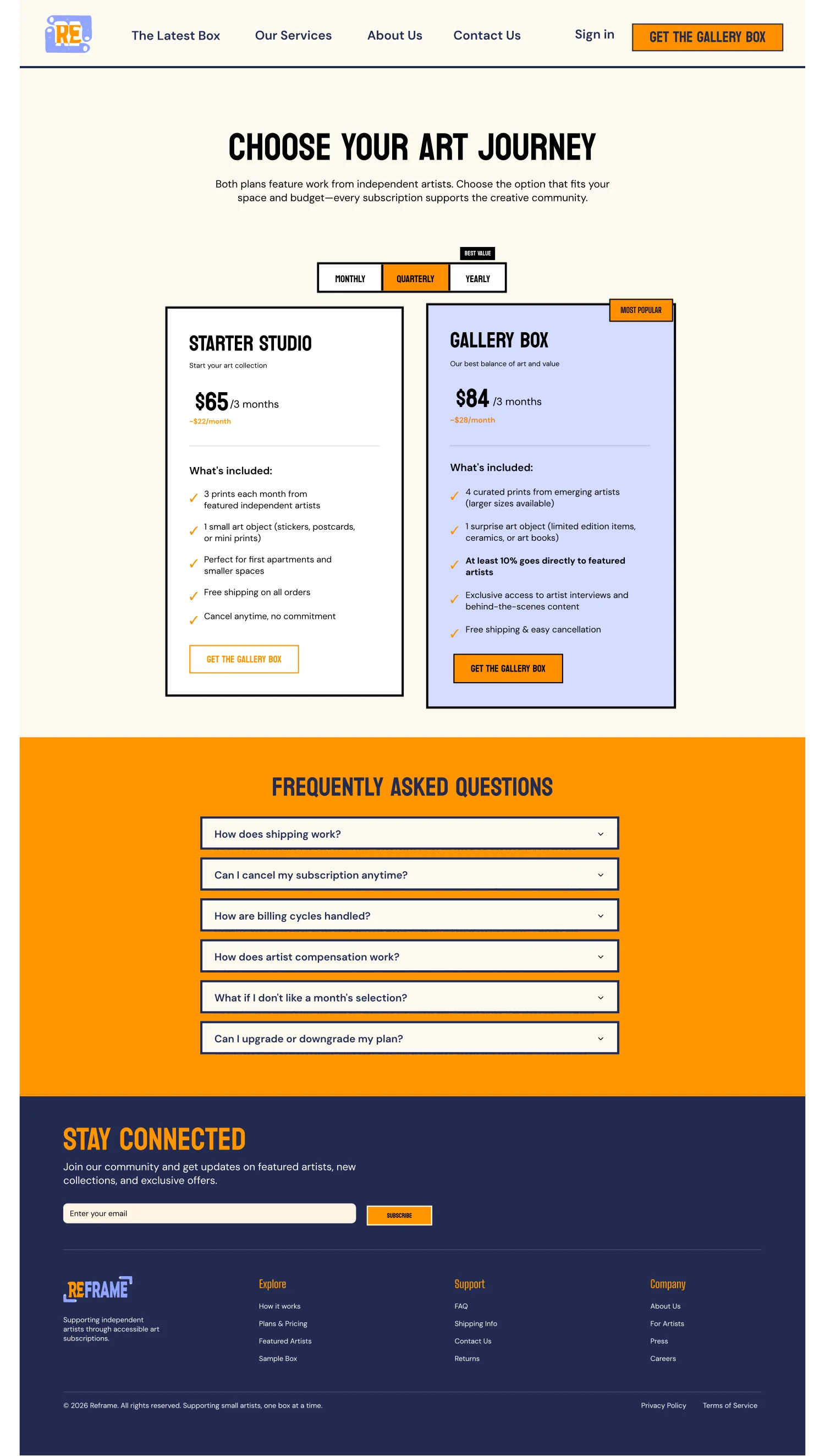
A tier structure built from the personas up.
I developed the pricing structure, working backward from what our target audience could realistically sustain. The tiered model creates a clear upgrade path while keeping the entry point genuinely accessible.
Starter Studio
Start your art collection
- 3 curated prints from featured independent artists
- 1 small art object (stickers, postcards, or mini prints)
- Perfect for first apartments and smaller spaces
- Free shipping on all orders
- Cancel anytime, no commitment
Gallery Box
Our best balance of art and value
- 4 curated prints from emerging artists (larger sizes available)
- 1 surprise art object (limited edition items, ceramics, or art books)
- At least 10% goes directly to featured artists
- Exclusive access to artist interviews and behind-the-scenes content
- Free shipping & easy cancellation
Starter Studio
Start your art collection
~$22/month · Save 7%
- 3 curated prints from featured independent artists
- 1 small art object (stickers, postcards, or mini prints)
- Perfect for first apartments and smaller spaces
- Free shipping on all orders
- Cancel anytime, no commitment
Gallery Box
Our best balance of art and value
~$28/month · Save 7%
- 4 curated prints from emerging artists (larger sizes available)
- 1 surprise art object (limited edition items, ceramics, or art books)
- At least 10% goes directly to featured artists
- Exclusive access to artist interviews and behind-the-scenes content
- Free shipping & easy cancellation
Starter Studio
Start your art collection
~$19/month · Save 17%
- 3 curated prints from featured independent artists
- 1 small art object (stickers, postcards, or mini prints)
- Perfect for first apartments and smaller spaces
- Free shipping on all orders
- Cancel anytime, no commitment
Gallery Box
Our best balance of art and value
~$25/month · Save 17%
- 4 curated prints from emerging artists (larger sizes available)
- 1 surprise art object (limited edition items, ceramics, or art books)
- At least 10% goes directly to featured artists
- Exclusive access to artist interviews and behind-the-scenes content
- Free shipping & easy cancellation
Collector's Edition tier—coming soon
Year One Financial Targets
Target subscribers by end of year one across Starter Studio and Gallery Box
Projected year-one revenue (blended across tiers and billing cadences)
Monthly retention target—a product built around repeat delight must earn the rebill
Paid directly to independent artists in the first 12–18 months
A bold visual system that made the concept feel real.
The ReFrame brand—Saul Bass-inspired, built around bold geometry, high contrast, and the "finger frame" logo device—gave the product a distinct personality that matched the confidence of the business model. The homepage direction was developed collaboratively; the onboarding experience was my full ownership.
Jump to the interactive prototype ↓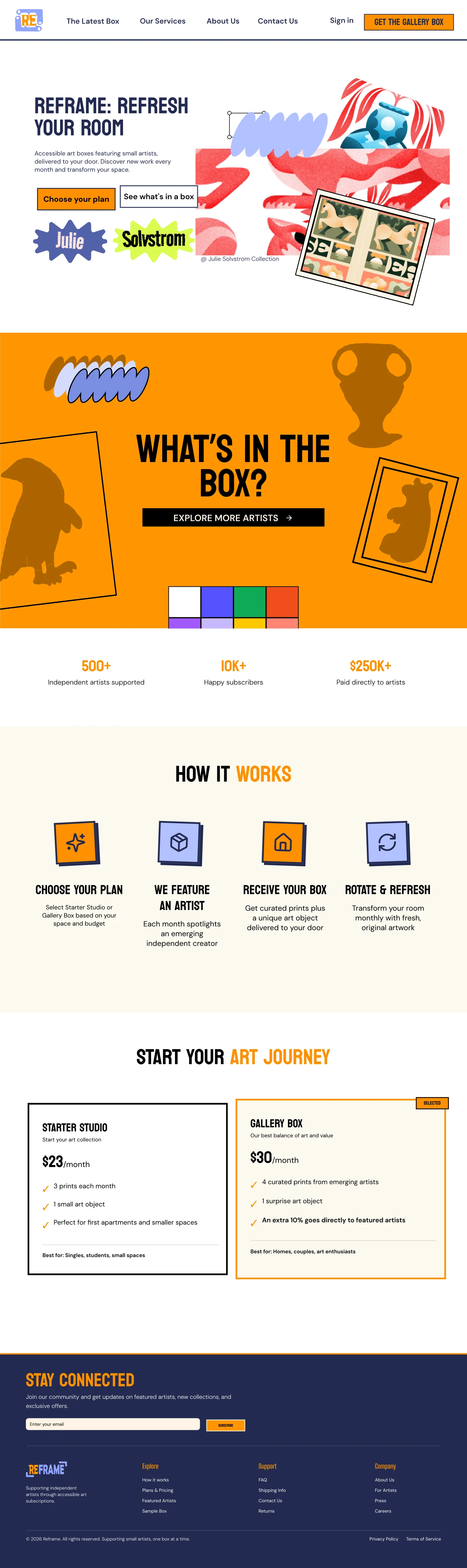
Helping users personalise the service and trust what they're getting.
I designed the entire onboarding experience end-to-end—from the first welcome screen through art style preference capture, subscription plan selection, and account confirmation. The flow was built to reduce cognitive load at the exact moment when a new subscriber is deciding whether this was worth it.

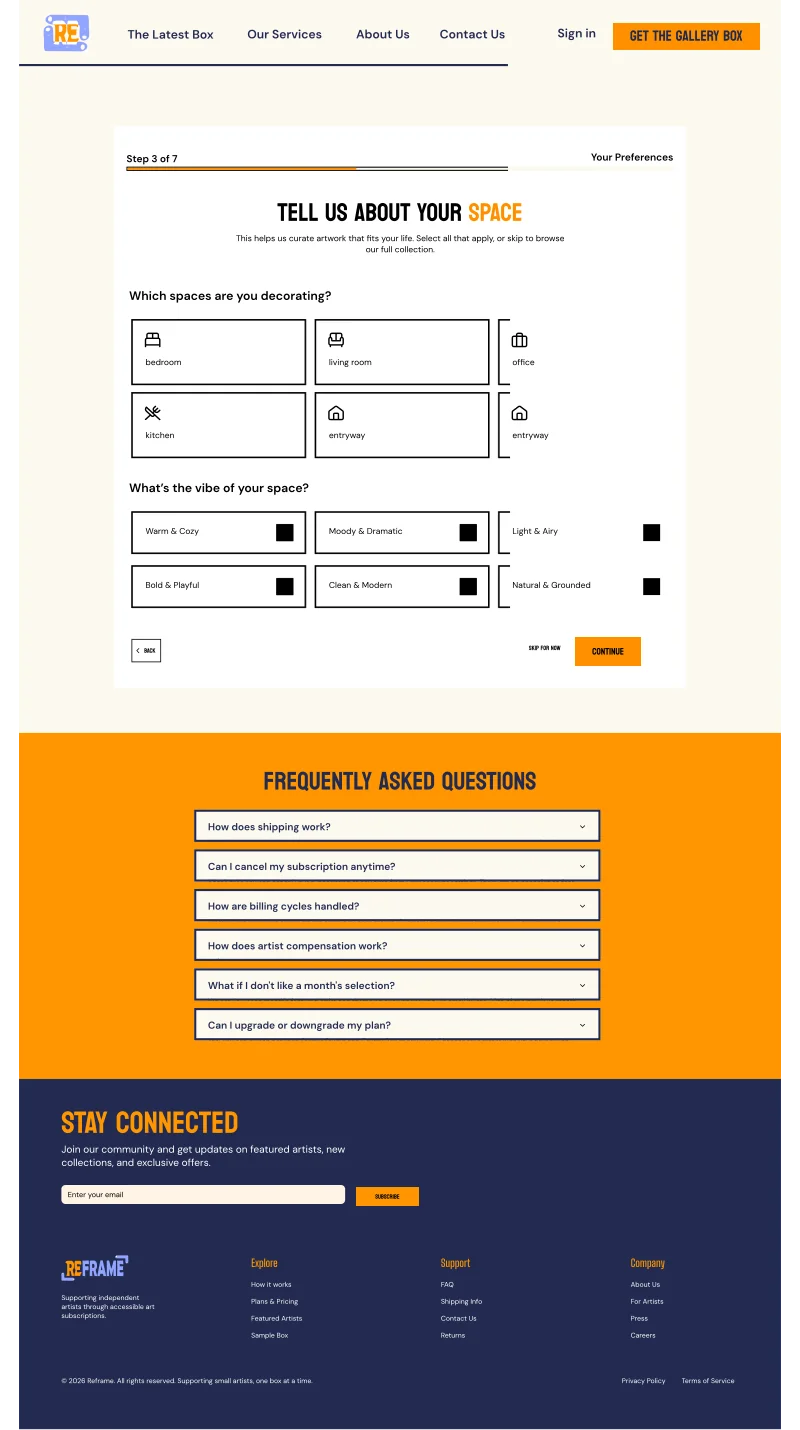
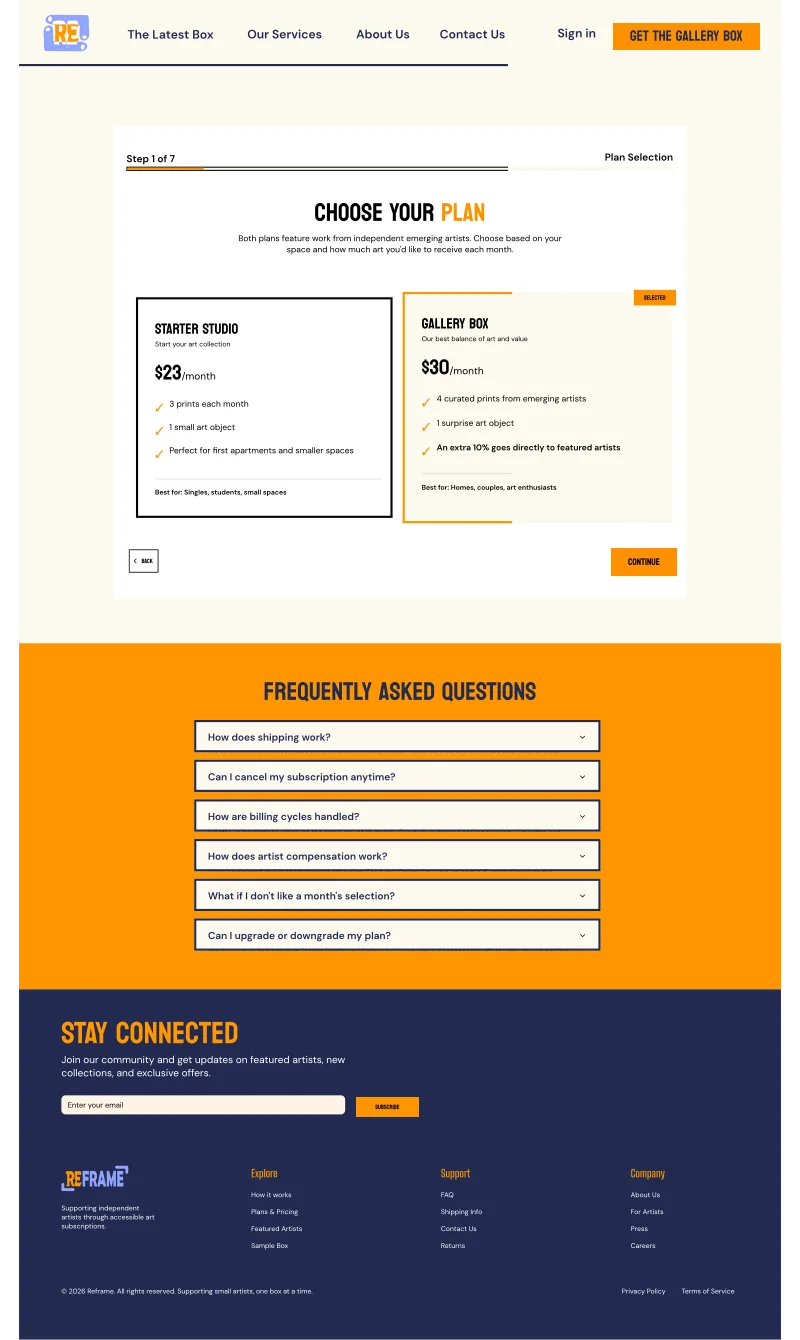

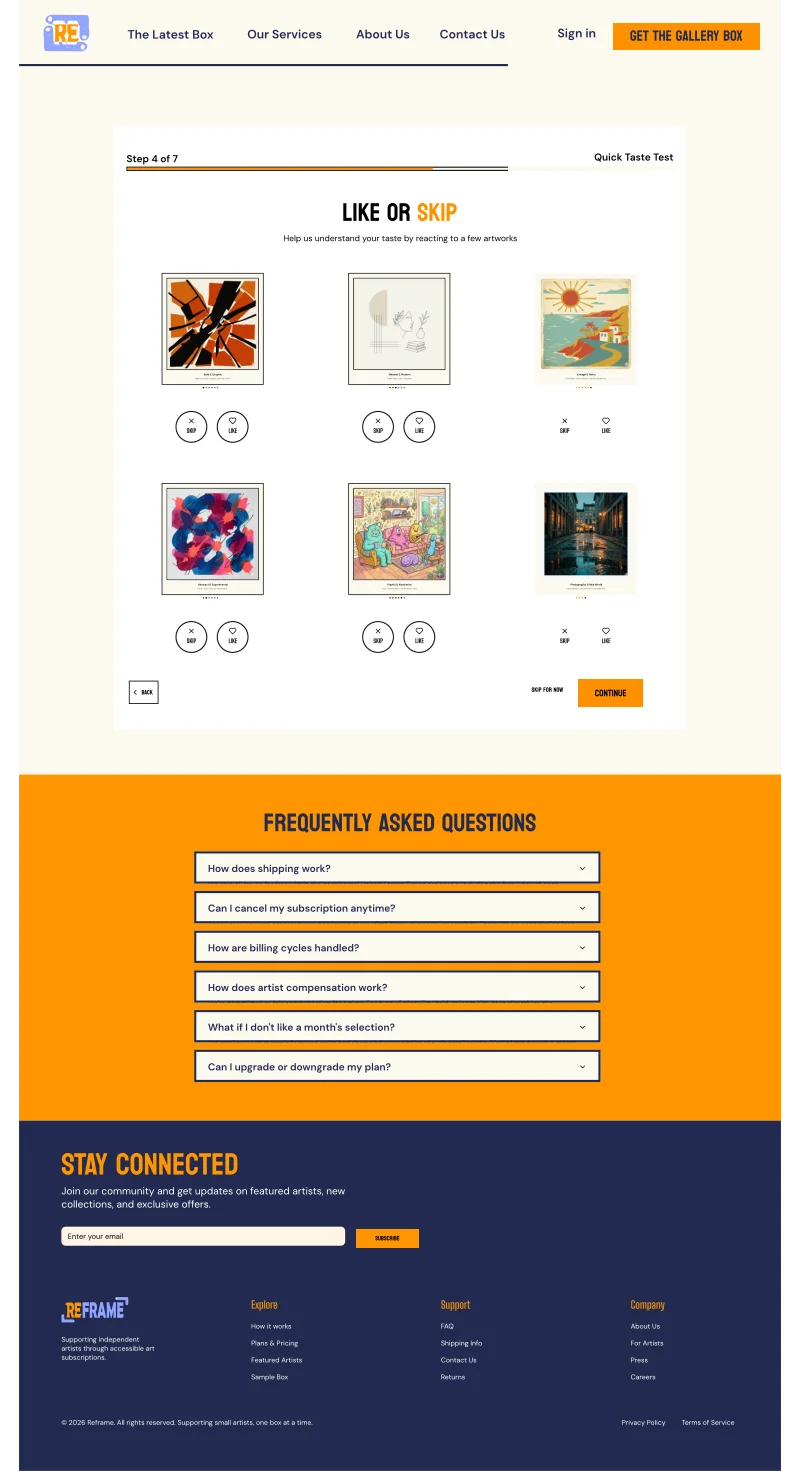


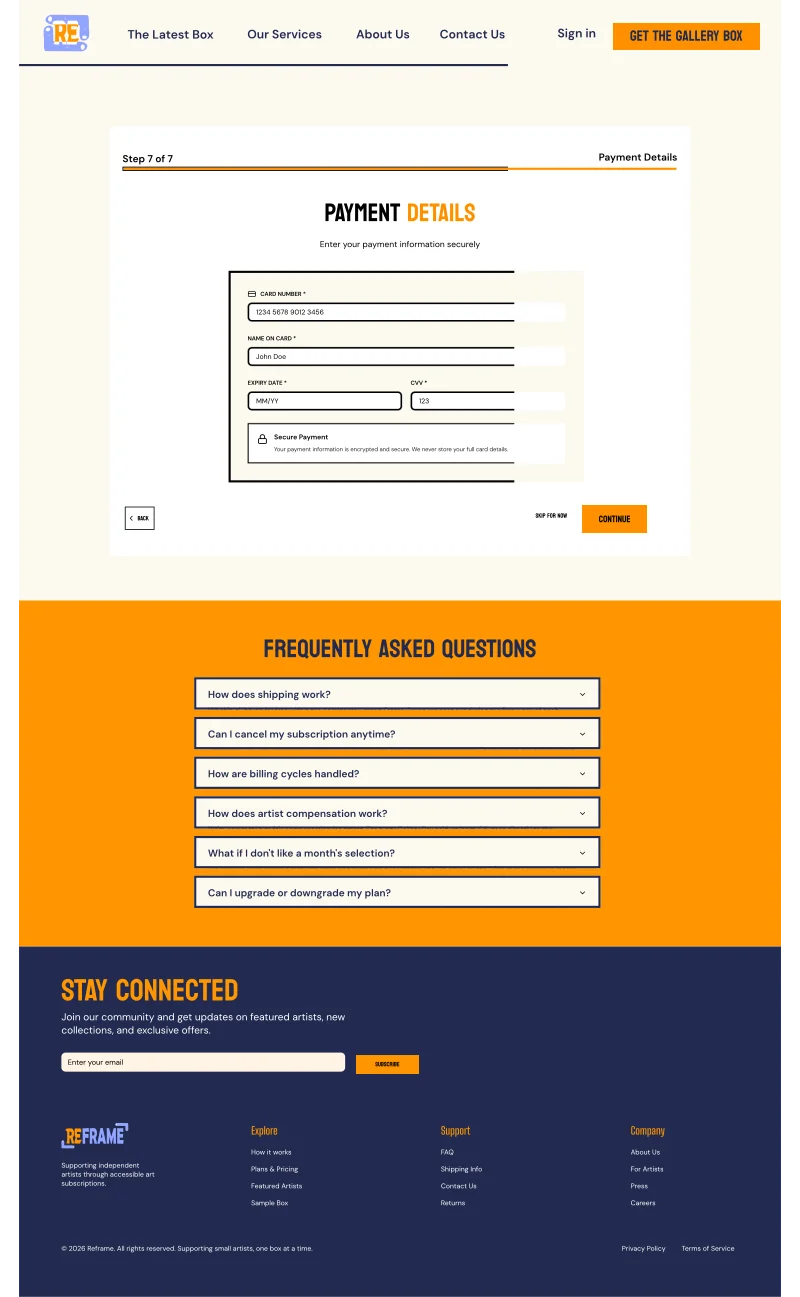
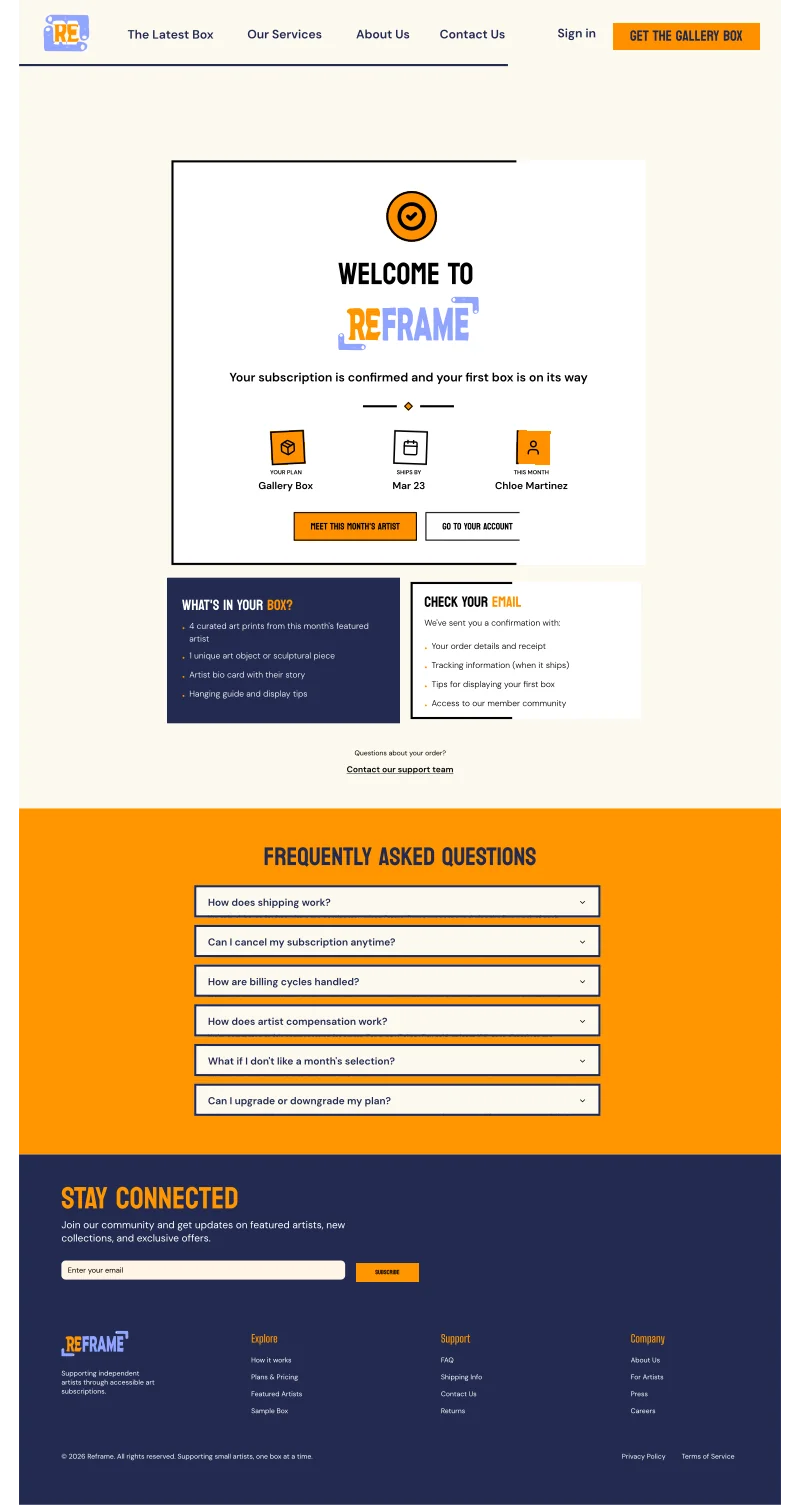
Try the onboarding flow.
Launch lean. Grow with the community.
The go-to-market strategy was designed around low-cost, high-trust acquisition channels that would work for a bootstrapped MVP—leaning on the artists themselves as distribution partners.
Social Content
Instagram + TikTok—unboxing content, artist stories, room reveals. Low cost, high shareability.
Artist Cross-Promo
Featured artists share with their audiences. Converts warm leads who already trust the creator.
Community & Word of Mouth
Referral incentives, local pop-ups, craft fairs. Builds trust in physical spaces where art is already valued.
Email Lifecycle
Welcome series, artist spotlights, upgrade nudges. Retention tool built into acquisition from day one.
A phased plan built to validate before scaling.
Beta Launch
Gallery Box beta with early adopters. Test contents, pricing, and unboxing experience. Validate demand before layering complexity.
MVBP Launch
Starter + Gallery tiers live. Monthly and quarterly billing. Full onboarding, artist spotlights, cohesive brand.
Scale & Refine
Yearly billing option. Upgrade nudge flows. Retention optimisation. Target 400+ subscribers.
Collector's Edition
Premium tier launch. Expanded artist roster. Potential retail partnerships.
Strategy and design, end to end.
This was a collaborative project. Here's an honest account of what I owned individually versus what we built together.
My Ownership
- Original concept—the rotating art service idea
- The pivot decision—identified the pricing problem and proposed the subscription box model
- Project naming—"ReFrame"
- Strategic planning and MVP scoping
- Pricing architecture—all three tiers, all three billing cadences
- All three personas (Maya, Jordan, Lina)
- Feature prioritisation (Must Have / Would Be Nice / Maybe Later)
- Sitemap
- Onboarding user flow (user + artist)
- Full onboarding screen design (9 screens)
- Sign-up page design
- Team meeting organisation and facilitation
Collaborative
- Brand identity (colour palette, typography, logo concept—co-created with team)
- Homepage design direction
- Competitive analysis and matrix
- Go-to-market strategy framing
- Pitch deck development
This project shows how I think about product—not just how I design it.
ReFrame gave me a chance to work in a fully strategic mode: identifying a market gap, making a pivotal business decision under real constraints, architecting the pricing, defining the audience, and then designing the experience that would make all of it legible to a first-time subscriber.
That combination—product thinking and execution ownership—is what I'm looking to bring to a Product Strategist role.
What This Demonstrates
- Ability to identify and act on a real market gap
- Strategic decision-making under constraint (the pivot)
- Pricing architecture grounded in audience economics
- Feature prioritisation that protects MVP scope
- End-to-end ownership of a complete user flow
- Honest, clear thinking about what I built vs. what we built together